








121 out of 131 districts in the North East were included in the Index.
• 103 districts (85%) are now classified as “Front Runner.”
• Hnahthial (Mizoram) recorded the highest score at 81.43.
• All districts in Mizoram, Sikkim and Tripura are Front Runners.
Introduction
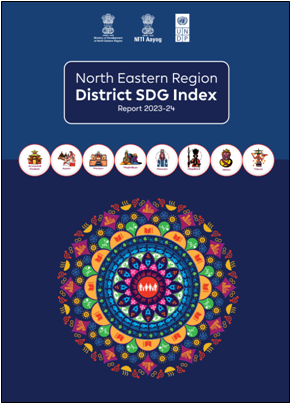
The Sustainable Development Goals offer a shared vision for a better, fairer and more inclusive world. For India’s North Eastern Region, where geography, diversity and development needs intersect, these goals provide a useful framework to measure progress and guide local action. Recognising this, NITI Aayog and the Ministry of Development of North Eastern Region (MoDoNER), with support from the United Nations Development Programme (UNDP), have released the second edition of the NER District SDG Index on 7 July 2025.
This report builds on the first edition, which was released on 26 August 2021, and tracks how districts across the eight North Eastern states are performing on 15 of the 17 Sustainable Development Goals. With better data systems, broader district coverage and stronger state involvement, the 2023–24 edition presents a more refined and reliable view of the region’s development path.
All districts in Mizoram, Sikkim and Tripura have achieved Front Runner status. Hnahthial in Mizoram stands out as the highest-scoring district, while states like Nagaland and Tripura have shown strong and balanced performances. The findings reflect the impact of national flagship schemes, focused localisation by states and the drive for saturation through initiatives like the Aspirational Districts Programme. This report is not just a performance snapshot but a tool for cooperation, policy action and shared progress on the path to sustainable development.
What are Sustainable Development Goals?
The Sustainable Development Goals or SDGs are a set of global targets adopted by the United Nations in 2015. They aim to improve lives, reduce poverty, protect nature, and promote peace by the year 2030. There are 17 goals and 169 targets in total, forming what is known as the 2030 Agenda for Sustainable Development. These goals are built on the idea that development must benefit everyone, especially the poor and vulnerable.

The SDGs are not only about growth. They look at how the world can become fairer, safer, cleaner, and more equal. This includes better healthcare, education, jobs, clean water, and a healthy environment. The vision is clear: no one should be left behind.
In India, NITI Aayog leads the work on SDGs. It links government schemes with the global goals and works closely with ministries to make sure every department plays its part. The United Nations team in India helps by offering support and ensuring that the goals are well connected, inclusive, and backed by proper funding.
Objectives of the NER District SDG Index 2023–24
The objectives of the NER SDG Index 2.0 are to:
- Rank the districts of the eight NER states based on their relative performance across the 15 SDGs. Goal 14 is not applicable and Goal 17 has limited relevance at the district level.
- Identify critical gaps and challenges in performance and achievements to plan necessary corrective measures.
- Highlight intra-state and inter-state disparities across the eight states to support the design of suitable interventions.
- Promote competitive federalism by enabling state-wise, district-wise, and SDG-wise comparisons. The ranking also acts as a tool for peer learning and performance improvement.
- Create a platform for collaboration and allow districts to share and adopt best practices from one another.
- Identify data gaps in the statistical systems of states and sectors where better and more frequent data collection is needed.
Coverage and Classification in the NER SDG Index 2023–24
The second edition of the NER District SDG Index covers 121 out of 131 districts in the region. This marks a clear step up from the first edition, which had data from 103 out of 120 districts. The expansion reflects better reporting and deeper involvement from the states.
The Index uses 84 indicators to measure progress. Out of these, 41 are based on data from Union Government sources, while the remaining 43 come from state-level systems. There has been a notable improvement in how districts report data to the Centre. This has made the results more credible and more useful for planning development work.
The Index tracks progress across 15 Sustainable Development Goals as shown below:
SDG No.
Goal
SDG 1
No Poverty
SDG 2
Zero Hunger
SDG 3
Good Health and Well-being
SDG 4
Quality Education
SDG 5
Gender Equality
SDG 6
Clean Water and Sanitation
SDG 7
Affordable and Clean Energy
SDG 8
Decent Work and Economic Growth
SDG 9
Industry, Innovation and Infrastructure
SDG 10
Reduced Inequalities
SDG 11*
Sustainable Cities and Communities
SDG 12
Responsible Consumption and Production
SDG 13
Climate Action
SDG 15
Life on Land
SDG 16
Peace, Justice and Strong Institutions
*Note: SDG 11 was scored only for 79 districts with urban bodies and was excluded from overall composite scores.