

Union Home Minister and Minister of Cooperation, Shri Amit Shah, today unveiled the National Cooperation Policy – 2025 in New Delhi. On this occasion, Union Minister of State for Cooperation Shri Krishan Pal Gurjar, Shri Murlidhar Mohol, Cooperation Secretary Dr. Ashish Kumar Bhutani, former Union Minister and chairman of drafting committee of new Cooperation Policy, Shri Suresh Prabhu, and many other dignitaries were present.
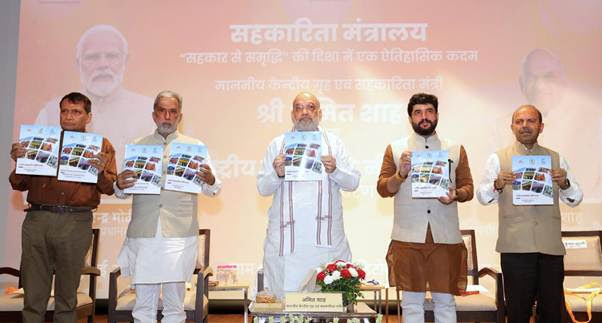
Addressing the unveiling ceremony of the National Cooperation Policy – 2025, Union Minister of Cooperation Shri Amit Shah said that under the leadership of Shri Suresh Prabhu, a 40-member committee has presented a comprehensive and visionary cooperation policy to the country’s cooperative sector after holding dialogue with various stakeholders. The Minister of Cooperation said that for a better future of cooperation, a 40-member committee was formed, which conducted regional workshops and held extensive discussions with cooperative leaders, experts, academicians, ministries, and all other stakeholders to draft the policy. The committee received about 750 suggestions, held 17 meetings, and after consultations with RBI and NABARD, finalized the policy.
Shri Amit Shah said that in 2002, for the first time, the Government of India introduced a Cooperation Policy, and even at that time, it was their party in power, with the late Atal Bihari Vajpayee as the Prime Minister. Now in 2025, when the Government of India has presented the second Cooperation Policy, it is again their party in power, with Shri Narendra Modi as the Prime Minister. Shri Amit Shah said that only a party with a vision and its understanding from the perspective of governance to achieve what is required for the country and its development, can give importance to the cooperative sector.
Union Minister of Cooperation Shri Amit Shah said that the new Cooperation Policy is a historic step toward fulfilling Prime Minister Shri Narendra Modi’s vision of ‘Sahkar Se Samriddhi’ (Prosperity through Cooperation). He said that the Modi government has set a goal for India to emerge as the world’s third-largest economy by 2027. Along with that, India also holds the responsibility for the inclusive development of its 1.4 billion citizens. He said that India’s core idea is to create a model in which there is a collective development for all, equitable growth for everyone, and national progress through the contributions from everybody.

Shri Amit Shah said that, almost 75 years after Independence, Prime Minister Shri Narendra Modi established the Ministry of Cooperation. At the time of its establishment, the cooperative sector was in a dilapidated state. He added that the greatest achievement of the Ministry of Cooperation — set up to fulfill Prime Minister Modi’s resolve of ‘Sahkar Se Samriddhi’— is that today, even the members of the smallest cooperative unit in the country feel pride and confidence. He said that in the past four years, the cooperative sector has stood on equal footing with the corporate sector by every measure. He added that before 2020, some people had declared the cooperative sector to be defunct, but now, they also acknowledge its importance and future.
Union Minister of Cooperation Shri Amit Shah said that while it is very important for India to become the world’s third-largest economy, equal attention must be given to the development of its 1.4 billion people. He emphasized that only the cooperative sector has the capacity to develop the nation’s economy inclusively with contributions from all 1.4 billion citizens. He said that the cooperative sector has a unique capability to pool small amounts of capital from many individuals to create large-scale enterprises. He stated that while formulating the Cooperation Policy, it was ensured that its core focus remained on the development of 1.4 billion people of India—especially villages, agriculture, rural women, Dalits, and tribals. He said that the vision of the new cooperation policy is to build a Viksit Bharat by 2047 through ‘Sahkar Se Samriddhi’. He explained that the mission of the policy is to promote small cooperative units that are professional, transparent, technology-enabled, accountable, economically self-reliant, and successful—and to ensure at least one cooperative unit is established in every village.
Shri Amit Shah further said that six pillars have been defined to achieve the set goals for the cooperative sector. These are: Strengthening the foundation, Promoting vibrancy, Preparing cooperative societies for the future, Enhancing inclusivity and expanding reach, Expanding into new sectors, and preparing the younger generation for cooperative development.
Union Minister of Cooperation said that the Ministry of Cooperation has prepared a detailed plan for sectors like tourism, taxi services, insurance, and green energy. He specifically mentioned that a remarkable start will be made in the taxi and insurance sectors in a very short time. He explained that the participation of cooperative units in these emerging sectors means that successful cooperatives will come together to form new cooperative entities, which will begin operations in these new areas. The profits generated through these units will ultimately reach the members of Primary Agricultural Credit Societies (PACS) at the rural level. He emphasized that the goal is to build a large and robust cooperative ecosystem. At the same time, the aim is to firmly establish the belief that cooperation can be a vital instrument for the country’s development for future generations.
Shri Amit Shah said that Prime Minister Shri Narendra Modi’s government is fully prepared to support cooperative institutions in every sector, 24 hours a day. However, he emphasized that the units must strengthen themselves from within. To this end, 83 intervention points have been identified. Out of these, work has been completed on 58 points, and 3 points have been fully implemented. There are 2 points that require continuous and ongoing implementation. The remaining points will now be taken up. He added that when all states implement this policy diligently, it will lead to the creation of an inclusive, self-reliant, and future-ready model, which will give a new shape to the country’s cooperative system.
Union Minister of Cooperation stated that a target has been set to triple the contribution of the cooperative sector to the country’s GDP by the year 2034. He acknowledged that this is a significant goal, but added that comprehensive preparations have been made to achieve it. A major objective is to bring 50 crore citizens, who are either not members or are inactive in the cooperative sector, into active participation. Additionally, there is a target to increase the number of cooperative societies by 30 per cent. Currently, there are 8.3 lakh societies, and this number will be increased by 30 per cent.
There will be at least one primary cooperative unit in every panchayat, which could be a Primary Agricultural Credit Society (PACS), Primary Dairy Cooperative, Primary Fisheries Cooperative, Primary Multipurpose PACS, or any other primary unit. These units will also help create more employment opportunities for youth. He emphasized that in order to enhance transparency, financial stability, and institutional trust, each unit must be empowered. For this, a cluster and monitoring system will also be developed.
Shri Amit Shah said that the Model Cooperative Village initiative was first launched in Gandhinagar, and it is an initiative of NABARD. He stated that efforts will be made to establish five model cooperative villages in every tehsil through state cooperative banks. The participation of women will be linked to this initiative through White Revolution 2.0. Shri Shah added that a roadmap has been prepared to implement all these schemes on the ground through two dedicated committees. Under the leadership of Prime Minister Narendra Modi, the Ministry of Cooperation is fully prepared to implement this policy in its entirety at the grassroots level. He noted that the policy includes key elements aimed at bringing significant transformation in the socio-economic structure of villages and ensuring that technology reaches even the smallest cooperative units over the next two decades. The computerization of processes will completely change operational methods, leading to increased transparency and efficiency. To foster competition, financial stability, transparency, and resilience to challenges in the cooperative sector, these changes will be implemented at the grassroots through a monitoring mechanism. Additionally, a system has been put in place to make necessary legal amendments every 10 years to keep the policy relevant and effective.